
Higher-for-Longer Yields Reset Market Expectations

Singapore
1. Core Weekly Stance: Stay Sidelined Amid Elevated Macro Volatility
Market participants are advised to avoid aggressive position opening and remain on the sidelines amid heightened cross-asset volatility this week. Without clear forward guidance from the Federal Reserve, markets have become extremely sensitive to every macro data print, resulting in frequent and violent price swings. Similar to the principle that excessive manipulation ruins outcomes, current market overreactions to policy ambiguity have greatly increased trading risks.
2. Rate Regime Returns: Long-End Yields Dominate Market Pricing
Earlier this week, a hawkish rate outlook report from Citadel ignited monetary tightening expectations. Combined with geopolitical tensions and hotter-than-expected PCE data, global markets experienced drastic fluctuations. The 10-year U.S. Treasury yield whipsawed sharply between 4.58% and 4.75%, hitting highs last seen in early 2015 during the stagflation pricing cycle.
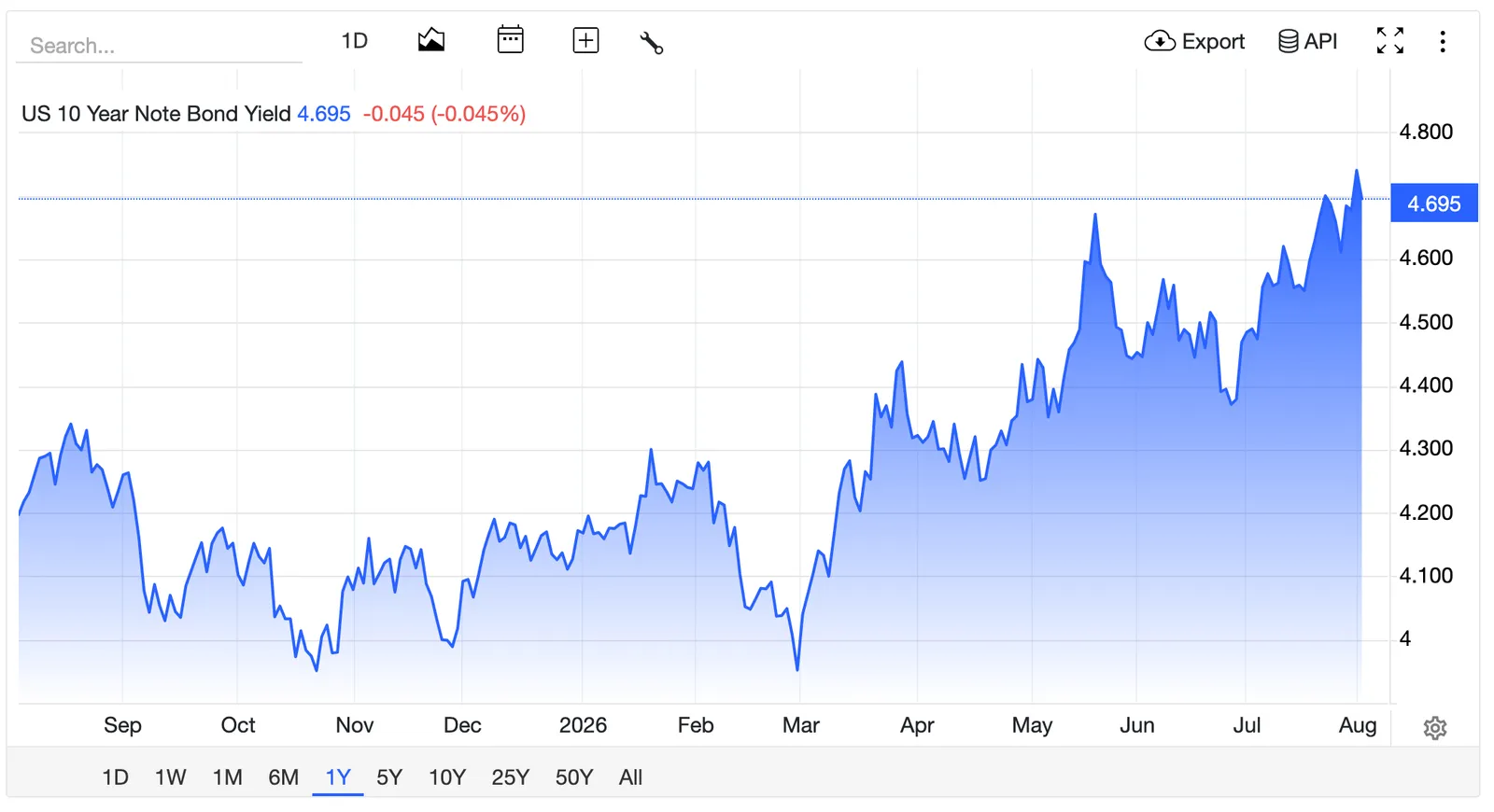
Long-dated U.S. yields have remained persistently elevated, re-establishing interest rates as the core driving variable of global asset pricing. The prolonged high-rate environment will continue suppressing valuations of growth-rich assets, especially technology stocks, in the coming months. The U.S. nonfarm payroll report due on Friday will be the top macro focus for next week’s market trend.
3. Yen Rebound: Intervention-Driven Volatility, Not Trend Reversal
The Japanese yen has maintained a sustained depreciation trend year-to-date and rebounded sharply last week following joint U.S.-Japan FX intervention. However, Japan’s inherent contradictions in fiscal conditions, inflation trends and monetary policy remain unresolved, while persistent pressure from U.S. Treasury markets cannot be fully eased.
The recent yen strength is merely short-term volatility brought by official intervention, rather than a fundamental reversal. The next two weeks serve as a favorable window for gradual yen selling and USD buying. If the U.S. Dollar Index continues strengthening and FX volatility moderates, yen carry trades are expected to regain market popularity.
4. AI Sector: Fundamentals Improve, But Stabilization Precedes Re-rating
Earnings results from global cloud hyperscalers and leading semiconductor firms including Samsung, SK Hynix and Kioxia have verified robust AI industry demand and improved ROIC across the sector. The sharp AI stock pullback in July failed to reflect these positive marginal fundamental changes.
Meanwhile, landmark market incidents have pushed overall market sentiment toward greater rationality. Fundamental advantages can only be fully priced in after market volatility fades, trading volume contracts and price trends stabilize. Despite near-term uncertainty, the latest sector correction has created a gradual accumulation opportunity for high-quality AI leaders including Google, Microsoft and NVIDIA.
Google stands out among AI plays with a complete commercial closed loop, covering underlying infrastructure, self-developed chips, proprietary AI models and diversified application scenarios, supported by nearly one billion global users, with current valuation levels remaining reasonable.
5. BTC Market: Gradual Decoupling From U.S. Tech Stock
In stark contrast to the violent swings of U.S. AI and technology equities, Bitcoin has maintained strong resilience, trading steadily within a range without obvious panic selling. A growing number of market discussions suggest Bitcoin is gradually breaking away from its long-term single correlation with tech stock trading logic, showing independent pricing characteristics.
6. Major Quantitative Regime Shift: Single-Beta Strategies Fall Out Of Favor
A critical market transformation has emerged in the quantitative space this week. Over the past year, mainstream quantitative strategies relying on high-beta tech exposure, momentum factors and AI thematic trades have suffered severe drawdowns, with multiple momentum strategies recording their worst performance in years.
This marks the end of the era of easy single-beta returns. Going forward, standalone beta gains will continue shrinking, industry rotation will accelerate, and relative value strategies, options trading, volatility management and multi-asset allocation will become increasingly critical.
Profit generation relying purely on single-asset beta exposure, such as tech indices or the Magnificent Seven basket, will grow increasingly difficult. Strategies with mature multi-asset allocation, relative value trading and options risk management capabilities will hold core competitive edges in the new market.
This is not investment advice. Markets are inherently volatile and unpredictable, and investors should always retain humility and respect for price action.